
The Cambrian explosion, or less commonly Cambrian radiation, was the relatively short evolutionary event, beginning around 542 million years ago in the Cambrian Period, during which most major animal phyla appeared, as indicated by the fossil record.

Rusophycus (presumably R. pectinatus, i.e. Cruziana pectinata sensu Seilacher) and other trace fossils from the Gog Formation (Middle Cambrian), Lake Louise, Alberta, Canada.
- wikipedia 
Lasting for about the next 20–25 million years, it resulted in the divergence of most modern metazoan phyla.

Stromatolites in the Pika Formation (Cambrian) near Helen Lake, Banff National Park, Canada.
- wikipedia 
Additionally, the event was accompanied by major diversification of other organisms. Prior to the Cambrian explosion, most organisms were simple, composed of individual cells occasionally organized into colonies.

Hallucigenia, a fitting icon for the Cambrian explosion taskforce. Vectorised from - wikipedia 

Basic coelomate body plan. Labels to be added via Template:Annotated_image, to aid internationalisation. Annotated version at Template:Coelomate basic.
- wikipedia 

Based on Image:Stemgroups.jpg by Grahbudd, modified to: provide stronger contrast for display at thumb size; rm legend to allow use of en:Template:Annotated image, which is more legible at thumb size.
- wikipedia 
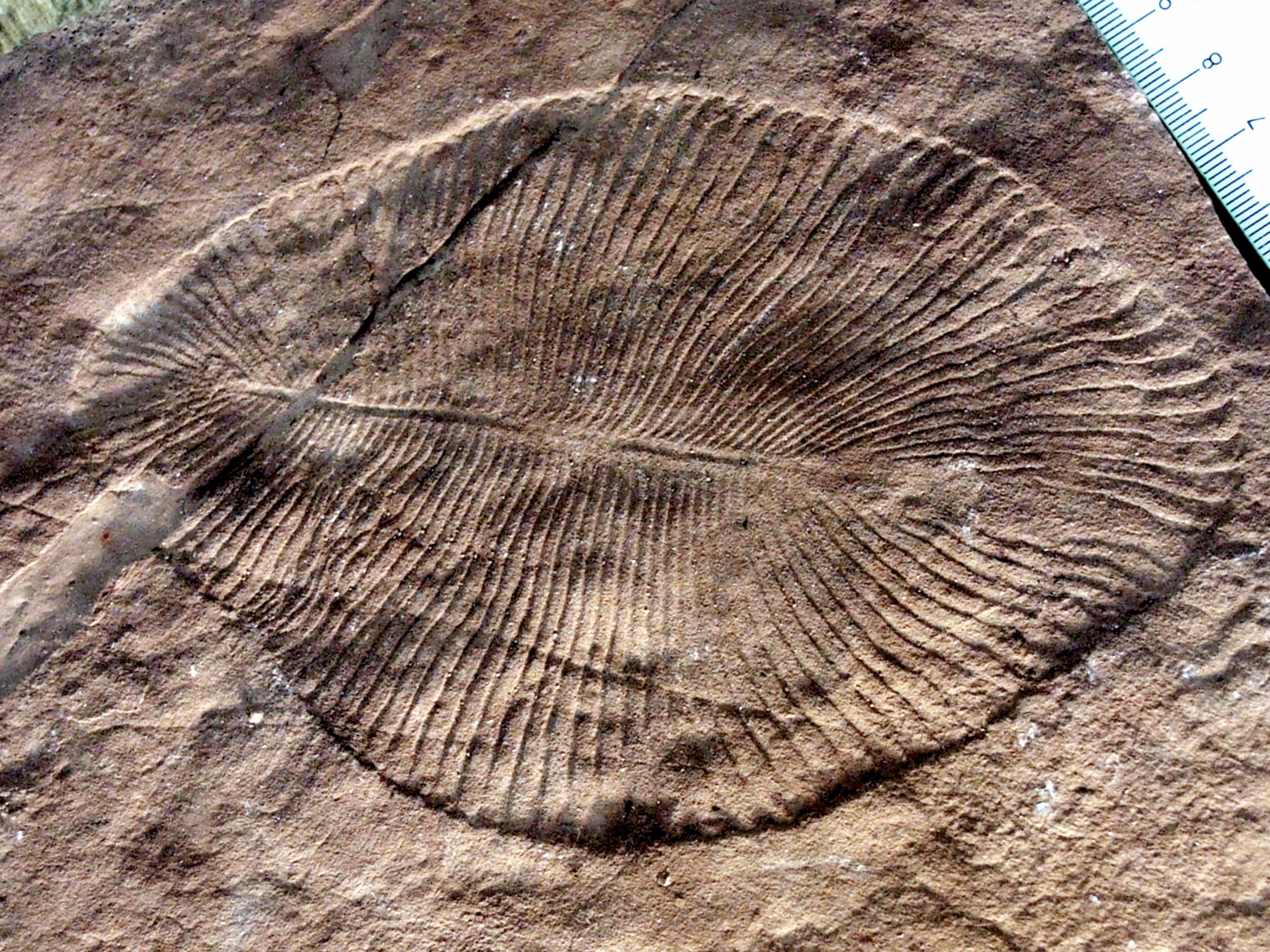
Cropped and digitally remastered version of another file masquerading as DickinsoniaCostata*.png (Can't remember which number should replace the *!)
- wikipedia 


Fossil of Marrella splendens (Marrellomorpha).
- wikipedia .png)

An oblique photo of a specimen belonging to Olenoides serratus. It shows the shiny carbon film that is the extremely thin remains of one of the antennae, and some of the biramous appendages. O. serratus is one of only about 20 trilobite species of which soft tissue has been preserved in some specimens. It is the only species for which cerci are known (paired unbrached terminal appendages of the pygidium, looking like antennas, but these are not shown in this photo
- wikipedia 
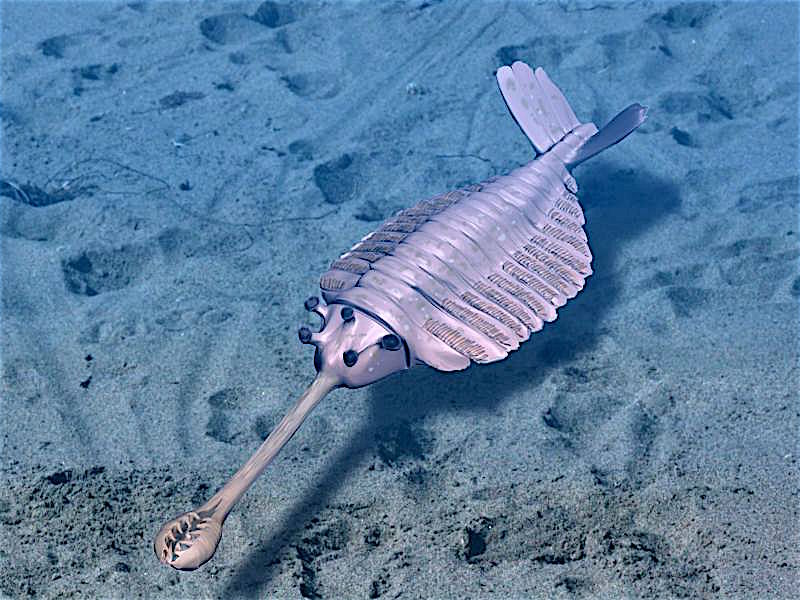
Opabinia regalis, from the Cambrian Burgess Shale. Digital.
- wikipedia 
Over the following 70 to 80 million years, the rate of diversification accelerated by an order of magnitude and the diversity of life began to resemble that of today. Many of the present phyla appeared during this period, with the exception of Bryozoa, which made its earliest known appearance in the Lower Ordovician.
The Cambrian explosion has generated extensive scientific debate. The seemingly rapid appearance of fossils in the “Primordial Strata” was noted as early as the 1840s, and in 1859 Charles Darwin discussed it as one of the main objections that could be made against the theory of evolution by natural selection.
The long-running puzzlement about the appearance of the Cambrian fauna, seemingly abruptly and from nowhere, centers on three key points: * whether there really was a mass diversification of complex organisms over a relatively short period of time during the early Cambrian * what might have caused such rapid change * what it would imply about the origin of animal life.
Interpretation is difficult due to a limited supply of evidence, based mainly on an incomplete fossil record and chemical signatures remaining in Cambrian rocks.


Phylogenetic analysis has been used to support the view that during the Cambrian radiation, metazoa evolved monophyletically from a single common ancestor: flagellated colonial protists similar to modern choanoflagellates.
# What caused the Cambrian explosion?
For most of the Earth's history, life consisted of the simplest organisms; but then something happened that would give rise to staggering diversity, and, ultimately, life as complex as that which we see today. Scientists are still struggling to figure out just what that was.
YOUTUBE qNtQwUO9ff8 What caused the Cambrian explosion? - The Economist